
Rohit is the person everyone calls. A friend is shifting house — Rohit arrives with a borrowed van. A cousin’s wedding needs someone to manage the guest list — Rohit again. He has hundreds of contacts, and his evenings are rarely his own. Then last month, when Rohit needed a few hands for his own house-shifting, three people were busy and two did not pick up. Sitting among the boxes, he asked himself a simple question: “I am there for everyone. Who is there for me?”
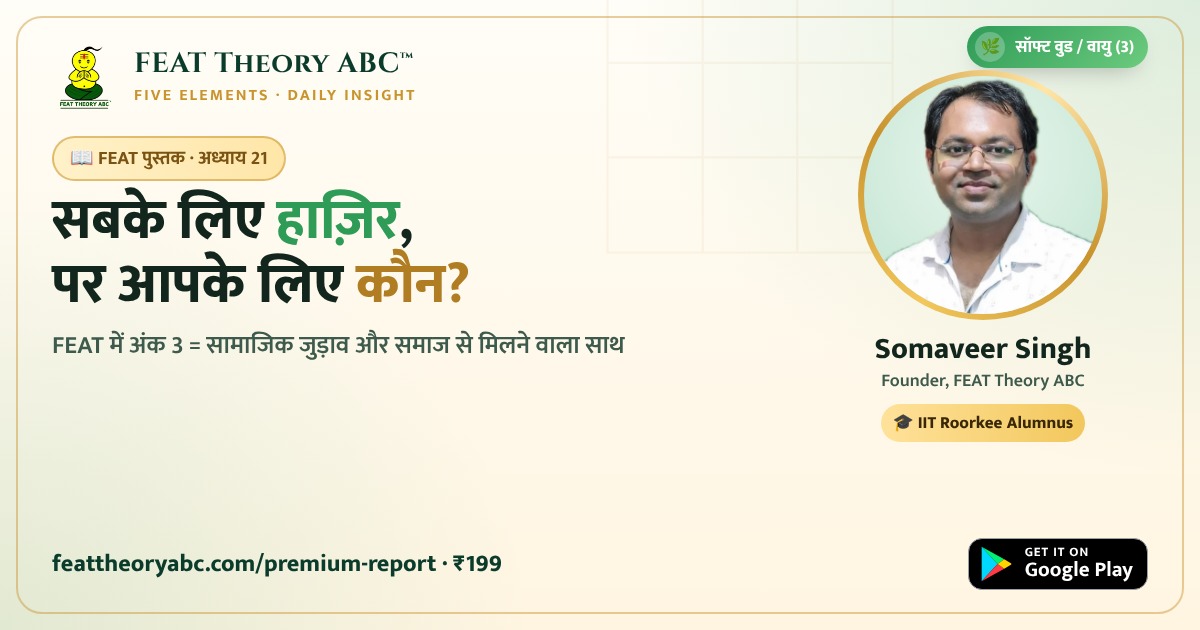
Many people know this feeling: a crowded phone book, and very few people to truly lean on. FEAT Theory ABC reads it through one number. In Chapter 21 of the book, “Soft Wood/Air Element in FEAT Theory ABC”, Somaveer Singh explains that Number 3 in the FEAT Birth Grid directly governs social connectivity and the level of support a person receives from society.
Number 3: the Soft Wood (Air) element
In FEAT, each number from 1 to 9 is linked to one of the five elements. Number 3 represents the Soft Wood element, also called the Air element, and it controls the energy of Jupiter (Guru) — the planet the book associates with wisdom, learning and expansion. Chapter 8 describes Air as the element of growth, learning and adaptability, and adds that in the FEAT Birth Grid, Number 3 represents social connectivity.
Chapter 21 names four areas where this element plays a key role:
- social connectivity and support from society;
- growth, learning and adaptability;
- opportunities and career growth;
- the influence of Jupiter (Guru).
Because Number 3 controls Jupiter’s energy, the book says its balance or imbalance directly affects social interactions, learning abilities and career growth.
First, count your 3s
The reading depends on how many times 3 appears in your FEAT Birth Grid. Write your full date of birth in DD/MM/YYYY format, place every digit in the grid (4 9 2 / 3 5 7 / 8 1 6), and add your Moolank and Bhagyank. Each appearance of a number counts as 50%. Present once (50%) is balanced. Present twice or more is imbalanced. Absent (0%) means the element is missing.
Three social patterns in the book
Balanced 3 (present once). According to Chapter 21, a single 3 brings strong, reliable and trustworthy friendships. Society is generally cooperative and offers help in times of need, and there is a balanced give-and-take of support between the person and society.
Imbalanced 3 (present multiple times). This is the pattern closest to Rohit’s story. The person may have many social contacts but struggles to find genuinely supportive people. The book notes high chances of being taken advantage of, and says some people may connect only for their own benefit, not for mutual growth. Its table shows how the pattern may build up: twice (100%), over-socialisation and some opportunistic people; three times (150%), people taking advantage and frequent requests for help; four or more times (200%+), being often used by others. When 3 is excessive, the chapter adds, frequent requests for help can lead to neglect of personal work — constantly helping without receiving benefits in return.
Missing 3 (absent). Here the picture is the opposite. Building reliable and lasting connections feels difficult, and help from society during difficult phases is minimal. The book links this with struggles in networking, fewer career opportunities, and minimal support from seniors, colleagues and subordinates — more work with fewer rewards. Progress in life can slow down due to a lack of supportive networks.
More than friendships: learning and career
Number 3 is not only about who answers your call. It also shapes how you learn and how opportunities reach you.
- Learning. A balanced 3 shows high curiosity, eagerness to learn and quick adaptation to new situations, with intelligence that can be applied in real life. A missing 3 may need repeated explanations and adapt slowly to change. Multiple 3s take up many learning activities but lack focus, and struggle to implement what they learn.
- Career. The book links a balanced 3 with timely opportunities, guidance from the right mentors, recognition from seniors and colleagues, and steady growth. With a missing 3, opportunities may be limited or arrive late, mentorship is harder to find, and professional success depends heavily on self-effort rather than external support. Multiple 3s may bring many opportunities but less clarity in choosing the right ones.
- Jupiter (Guru). A balanced 3 receives steady blessings of Jupiter, linked to wise decision-making, strong judgement and continuous learning. A missing 3 means a weak influence of Jupiter and fewer chances for higher learning. With excess 3, the book says excess Jupiter energy may cause overconfidence or scattered thinking — trying to follow too many paths at once and diluting focus.
The book’s advice for the person everyone calls
Chapter 21 closes with an important piece of advice for people with excess Number 3: be cautious in choosing your social circle, set boundaries, prioritise your own work, and learn to say “No” when needed, so that you avoid unnecessary struggles.
This is not a call to stop caring for others. The balanced picture in the same chapter is still a give-and-take of help. The aim is reliable, trustworthy friendships rather than a long list of contacts who remember you only when they need something.
Start with your own grid
FEAT is analysis, not a fixed prediction. Number 3 is one part of a larger picture that also includes Water, Fire, Earth and Metal, your name and your present life. The chapter’s conclusion sums it up: Number 3 plays a major role in social connectivity, career growth and learning ability, and a balanced Soft Wood element is linked with strong support from society and new opportunities. For Rohit, the first step is not to become less kind. It is to count his 3s, understand his pattern, and choose where his time goes.
हिन्दी सारांश
FEAT Theory ABC (अध्याय 21) के अनुसार अंक 3 = सॉफ्ट वुड / वायु तत्व, जो गुरु (Jupiter) की ऊर्जा से जुड़ा है। FEAT Birth Grid में यही अंक सामाजिक जुड़ाव और समाज से मिलने वाले साथ को दिखाता है, और सीखने, बदलाव के साथ ढलने तथा करियर के मौक़ों पर भी असर डालता है। 3 एक बार (संतुलित) — मज़बूत, भरोसेमंद दोस्ती, ज़रूरत पर समाज का साथ और मदद का बराबर लेन-देन। 3 कई बार (असंतुलित) — जान-पहचान बहुत, पर सच्चा साथ देने वाले कम; तीन या ज़्यादा बार हो तो मदद की माँगें बार-बार आती हैं और अपना काम पीछे छूट सकता है। 3 ग़ायब — भरोसेमंद, टिकाऊ जुड़ाव बनाने में मुश्किल, और पेशेवर तरक़्क़ी ज़्यादातर अपनी मेहनत के भरोसे। पुस्तक की सलाह: ज़्यादा 3 वाले अपना दायरा सोच-समझकर चुनें, सीमाएँ तय करें, अपने काम को प्राथमिकता दें और ज़रूरत पर ‘ना’ कहना सीखें। याद रखिए — FEAT analysis है, पक्की भविष्यवाणी नहीं।
See how many times Number 3 appears in your own FEAT Birth Grid.
FEAT Premium Report · ₹199 · Vedic Kundli + Numerology + Five Elements (FEAT) · Hindi + English PDF on WhatsApp.
Get your FEAT Premium Report →
Or download the FEAT Theory ABC app on Google Play.
Frequently asked questions
What does Number 3 represent in FEAT Theory ABC?
Number 3 is the Soft Wood (Air) element and controls the energy of Jupiter (Guru). According to Chapter 21, it governs social connectivity and support from society, and also plays a key role in learning, adaptability and career opportunities.
Are many 3s in the grid good for social life?
Not necessarily. In FEAT, a single 3 (50%) is balanced. When 3 appears multiple times, the book says a person may have many contacts but struggle to find genuinely supportive people. When it is excessive (more than 100%, three or more times), frequent requests for help can pull them away from their own work.
What if Number 3 is missing from my FEAT Birth Grid?
The book links a missing 3 with difficulty in building reliable, lasting connections, less help from society during difficult phases, and professional success that depends more on self-effort. It is one part of your analysis, read together with the other elements — not a fixed verdict.
— Based on Chapter 21, “Soft Wood/Air Element in FEAT Theory ABC”, with Chapters 8–9, from the book FEAT Theory ABC by Somaveer Singh (Founder, FEAT Theory ABC · IIT Roorkee alumnus).
