
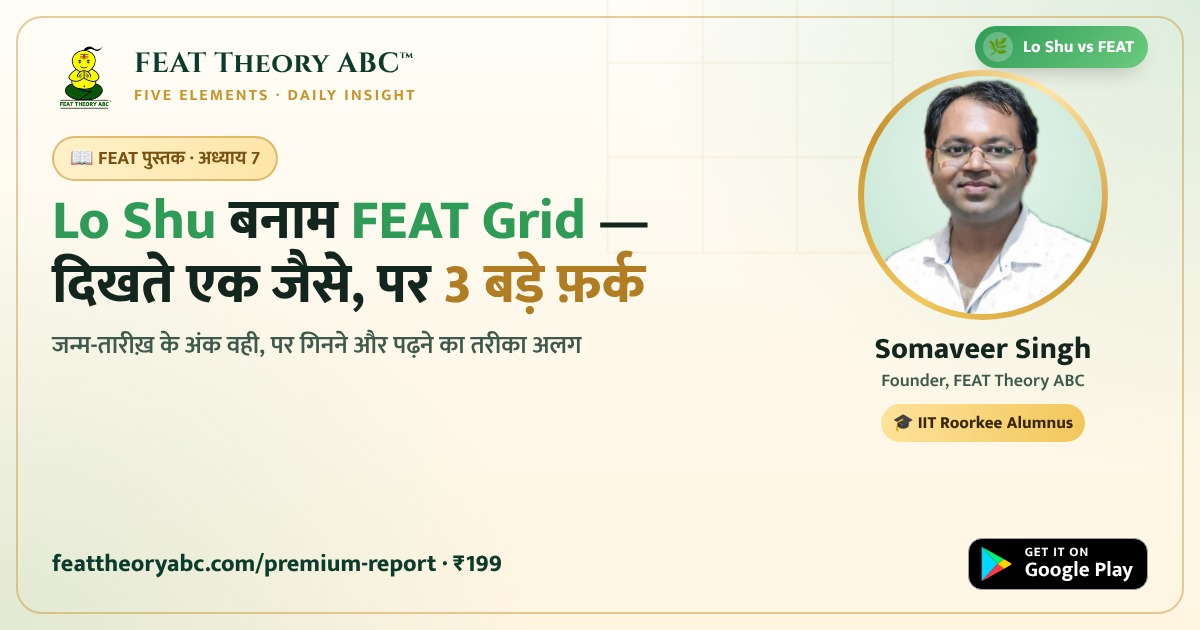
If you have ever drawn your Lo Shu Grid, the FEAT Birth Grid will look familiar. Both come from the same Standard Lo Shu Grid — a 3x3 magic square filled with the digits of your date of birth. But the way the two grids are filled and read is different, and those differences change the result.
This guide is based on Chapter 7 of the book FEAT Theory ABC by Somaveer Singh.
Difference 1: the Moolank is always included
In traditional numerology, if you were born on a single-digit date (1st, 2nd, 3rd and so on), the Moolank (root number) is not added to the Lo Shu Grid. In FEAT Theory ABC the Moolank is always included, whether the date is single-digit or double-digit.
The reason: in FEAT Theory ABC the Moolank represents your identity — your natural personality, nature and behaviour. As the book puts it, if you remove the Moolank, you are removing your own presence from your birth grid.
Difference 2: the KUA number is never added
Traditional numerology sometimes adds an extra number, the KUA number, to the Lo Shu Grid. It is not derived from your date of birth directly; it is calculated separately, mainly in feng shui.
According to FEAT Theory ABC, adding the KUA number disturbs the concentration level of the five elements: it artificially increases certain energies and creates imbalances. That is why the KUA number is never included in the FEAT Birth Grid.
Difference 3: the purpose of the grid
The traditional Lo Shu Grid is mostly used for general prediction from numbers alone. The FEAT Birth Grid is used to measure the concentration level of the five elements in the body — numbers plus elements plus real-life energy flow — for elemental analysis and life balance.
Two examples from the book
Date of birth 09/04/1990
Moolank = 0 + 9 = 9. Bhagyank = 0+9+0+4+1+9+9+0 = 32 = 5. All digits of the date go into the grid together with the Moolank and the Bhagyank, so 9 appears four times, while 4, 1 and 5 appear once each.
Date of birth 21/10/1985
Moolank = 2 + 1 = 3. Bhagyank = 2+1+1+0+1+9+8+5 = 27 = 9. In the FEAT Birth Grid, 1 appears three times, 9 twice, and 2, 3, 5 and 8 once each.
Why every digit matters in FEAT
In FEAT Theory ABC every number in your date of birth contributes to the elemental concentration in your body. The Moolank is included because it is your identity, and the Bhagyank because it is your destiny or universal path — it governs how your body absorbs the energy it keeps receiving from the universe.
हिन्दी सारांश
Lo Shu Grid और FEAT Birth Grid एक ही 3x3 वर्ग से बनते हैं, पर तीन बड़े फ़र्क हैं: (1) FEAT Grid में मूलांक हमेशा जुड़ता है, तारीख़ एक अंक की हो तब भी — क्योंकि मूलांक आपकी पहचान है; (2) KUA नंबर FEAT Grid में कभी नहीं जुड़ता, क्योंकि वह तत्वों का concentration बिगाड़ता है; (3) FEAT Grid का मकसद सिर्फ़ भविष्यवाणी नहीं, बल्कि शरीर में पाँच तत्वों का concentration नापना है।
See your own FEAT Birth Grid and which element is strong or weak in you.
FEAT Premium Report · ₹199 · Vedic Kundli + Numerology + Five Elements (FEAT) · Hindi + English PDF on WhatsApp.
Get your FEAT Premium Report →
Or download the FEAT Theory ABC app on Google Play.
Frequently asked questions
Is the FEAT Birth Grid the same as the Lo Shu Grid?
Both start from the same 3x3 Lo Shu square, but the FEAT Birth Grid always includes the Moolank, never adds the KUA number, and is read for the concentration of the five elements.
Why is the KUA number not used in FEAT Theory ABC?
Because it is not derived from the date of birth and, according to FEAT Theory ABC, it disturbs the natural concentration level of the five elements.
Do I include my Moolank if I was born on a single-digit date?
Yes. In the FEAT Birth Grid the Moolank is always included, because it represents your identity.
— Based on Chapter 7, "Is the Lo Shu Grid and Feat Birth Grid the Same?", from the book FEAT Theory ABC by Somaveer Singh (Founder, FEAT Theory ABC · IIT Roorkee alumnus).
